
← Back To Blogs
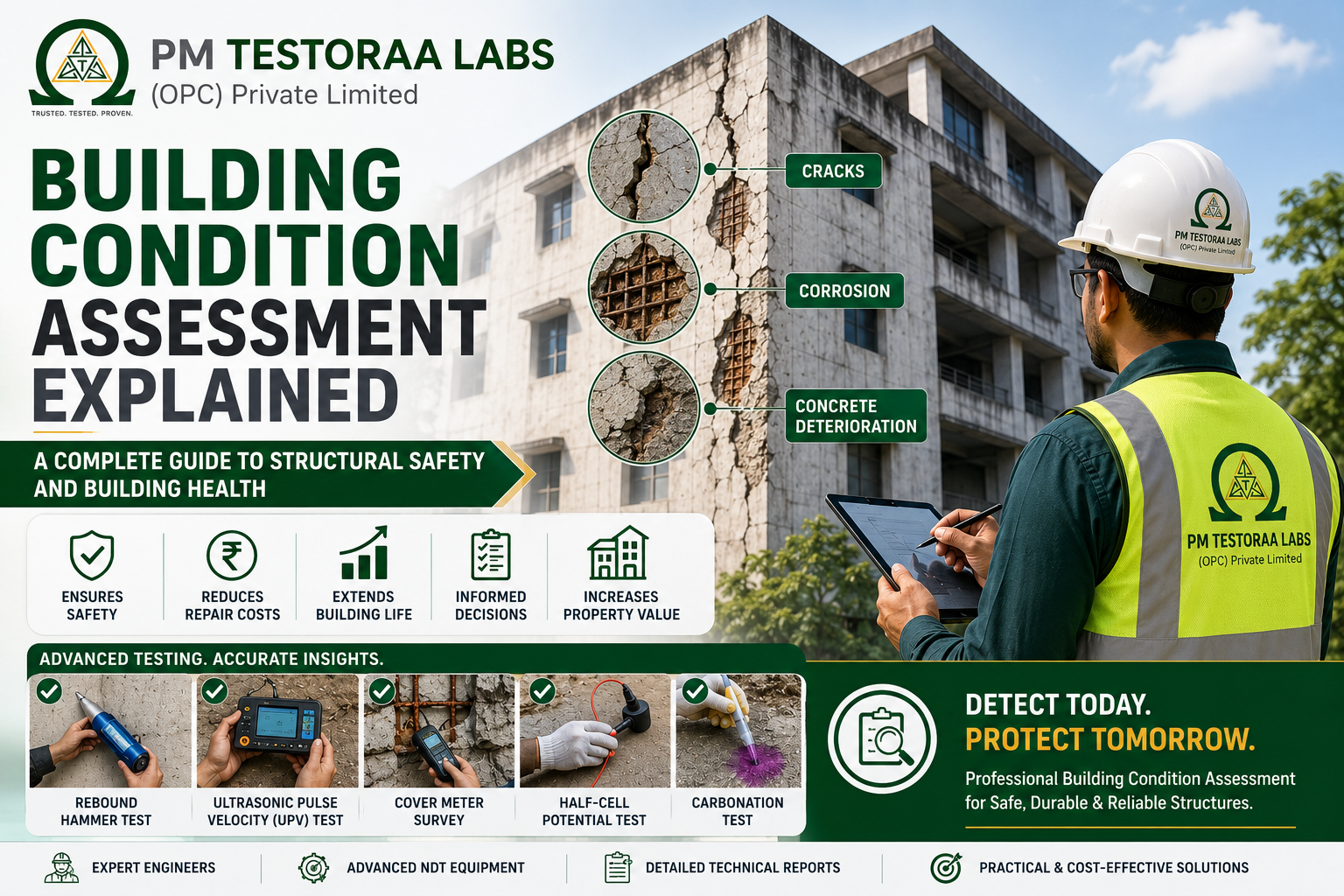
Building Condition Assessment Explained: Signs, Tests, Benefits & Process
Coimbatore 01 Jul 2026
Building Condition Assessment Explained: A Complete Guide for Property Owners
Building Condition Assessment Explained
Every building gradually deteriorates with age due to environmental exposure, material degradation, overloading, poor maintenance, or changes in usage. While some defects are visible, many structural problems remain hidden until they become serious and expensive to repair.
A Building Condition Assessment (BCA) is a systematic evaluation of a building's structural, architectural, and serviceability condition. It helps property owners understand the current health of their building, identify defects at an early stage, and make informed maintenance or rehabilitation decisions.
Whether you own a residential house, apartment, commercial building, factory, hospital, school, or industrial facility, periodic condition assessment is essential for ensuring safety, durability, and compliance.
What is Building Condition Assessment?
A Building Condition Assessment (BCA) is a professional engineering inspection conducted to evaluate the physical condition, structural integrity, durability, and remaining service life of an existing building.
The assessment involves:
Visual inspection
Structural distress mapping
Non-Destructive Testing (NDT)
Material strength evaluation
Corrosion assessment
Crack investigation
Foundation performance review
Preparation of a detailed technical report
The objective is not merely to identify defects but also to determine why they occurred and recommend appropriate corrective measures.
Why is Building Condition Assessment Important?
Regular building assessments provide several benefits:
1. Ensures Structural Safety
Hidden deterioration may lead to partial or complete structural failure. Early detection helps prevent accidents.
2. Reduces Repair Costs
Minor defects can often be repaired economically. Delayed maintenance usually results in costly rehabilitation.
3. Extends Building Life
Timely repairs significantly improve the service life of buildings.
4. Supports Property Valuation
Condition assessment reports provide confidence to buyers, investors, and financial institutions.
5. Assists Renovation Planning
Before renovation or adding extra floors, the existing structural capacity must be evaluated.
6. Insurance and Legal Documentation
Detailed assessment reports are often required for insurance claims, dispute resolution, and regulatory approvals.
When Should a Building be Assessed?
A professional building condition assessment is recommended when:
Building is more than 15–20 years old
Major structural cracks appear
Water leakage becomes frequent
Reinforcement corrosion is visible
Concrete starts spalling
Building experiences settlement
Additional floors are proposed
Change in occupancy is planned
After earthquake, flood, cyclone, or fire
Before buying or selling a property
Common Signs of Structural Distress
Early identification of these symptoms can prevent major failures.
Structural Cracks
Beam cracks
Column cracks
Slab cracks
Wall cracks
Staircase cracks
Concrete Deterioration
Honeycombing
Spalling
Delamination
Surface scaling
Corrosion
Rust stains
Exposed reinforcement
Expansion cracks
Foundation Problems
Uneven settlement
Tilting walls
Floor depression
Water Damage
Dampness
Seepage
Efflorescence
Mold growth
Stages of Building Condition Assessment
1. Preliminary Site Inspection
Engineers inspect the building to understand:
Building age
Structural system
Usage history
Visible damages
Previous repairs
Photographs and measurements are recorded.
2. Visual Condition Survey
A detailed visual inspection identifies:
Cracks
Deflections
Corrosion
Dampness
Leakage
Concrete damage
Each defect is documented with its location, dimensions, and severity.
3. Non-Destructive Testing (NDT)
Various NDT methods help evaluate structural health without damaging the building.
Rebound Hammer Test
Purpose:
Estimate the surface hardness and indicative compressive strength of concrete.
Suitable for:
Columns
Beams
Slabs
Walls
Ultrasonic Pulse Velocity (UPV) Test
Purpose:
Evaluate concrete quality and detect internal cracks or voids.
Provides information on:
Concrete uniformity
Internal defects
Honeycombing
Cracks
Cover Meter Survey
Determines:
Reinforcement location
Concrete cover thickness
Bar spacing
Useful before drilling or repairs.
Half-Cell Potential Test
Assesses the probability of reinforcement corrosion.
Commonly used for:
Coastal structures
Bridges
Old RCC buildings
Carbonation Test
Measures carbonation depth.
Carbonation lowers concrete alkalinity, allowing reinforcement corrosion.
Core Cutting (If Required)
Concrete cores are extracted for laboratory testing to determine actual compressive strength.
This semi-destructive test is performed only when necessary.
Structural Analysis
Collected field data are analyzed to evaluate:
Load-carrying capacity
Structural stability
Safety margins
Serviceability
Remaining useful life
If required, engineers prepare analytical models for detailed structural evaluation.
Typical Defects Identified During Assessment
The assessment may reveal:
Concrete deterioration
Corrosion of reinforcement
Excessive deflection
Foundation settlement
Water ingress
Roof leakage
Cracked beams
Damaged columns
Slab distress
Masonry cracks
Poor previous repairs
Construction defects
Recommendations Provided in the Report
Depending on the observed condition, recommendations may include:
Minor Repairs
Crack sealing
Waterproofing
Surface repairs
Moderate Repairs
Concrete patch repair
Corrosion treatment
Protective coatings
Structural Strengthening
Jacketing of columns
Beam strengthening
FRP wrapping
Steel plate bonding
Rehabilitation
Major structural restoration for deteriorated buildings.
Demolition Recommendation
In severely distressed buildings where repairs are not technically or economically feasible.
Deliverables of a Building Condition Assessment Report
A professional report generally includes:
Executive summary
Building details
Inspection methodology
Visual observations
Structural distress mapping
Test results
Photographic evidence
Engineering analysis
Risk assessment
Repair recommendations
Maintenance plan
Conclusion
Benefits of Periodic Building Condition Assessment
Regular assessments help:
Improve occupant safety
Detect problems early
Reduce maintenance costs
Increase building lifespan
Support renovation decisions
Enhance property value
Ensure regulatory compliance
Improve disaster resilience
Why Choose TESTORAA Labs?
At TESTORAA Labs, we provide comprehensive Building Condition Assessment services using modern inspection techniques and engineering expertise.
Our services include:
Visual Structural Inspection
Rebound Hammer Testing
Ultrasonic Pulse Velocity (UPV) Testing
Concrete Cover Meter Survey
Carbonation Testing
Crack Mapping
Structural Health Assessment
Structural Audit
Repair & Rehabilitation Recommendations
Detailed Technical Reports
Our experienced engineers deliver reliable, accurate, and practical solutions that help clients maintain safe and durable structures.
Conclusion
A building is one of the most valuable investments a person or organization makes. Like any important asset, it requires periodic evaluation to ensure long-term safety and performance.
A professional Building Condition Assessment helps identify hidden defects, assess structural integrity, and recommend timely maintenance or rehabilitation measures. Regular assessments not only extend the life of a structure but also reduce repair costs, enhance safety, and protect property value.
Whether your building is newly constructed, decades old, or showing signs of deterioration, a condition assessment provides the information needed to make confident engineering decisions.
Frequently Asked Questions (FAQs)
Q1. How often should a Building Condition Assessment be conducted?
Residential and commercial buildings should generally be assessed every 5–10 years, while older buildings (over 15–20 years) or structures exposed to harsh environments may require more frequent inspections.
Q2. Is Building Condition Assessment destructive?
No. Most assessments rely on Non-Destructive Testing (NDT) methods that evaluate the structure without causing damage. Semi-destructive tests, such as concrete core sampling, are performed only when necessary.
Q3. Can a Building Condition Assessment estimate the remaining life of a building?
Yes. Based on inspection findings, material tests, and structural analysis, engineers can provide an estimate of the building's remaining service life and recommend maintenance or strengthening measures.
Q4. What is the difference between a Structural Audit and a Building Condition Assessment?
A Building Condition Assessment focuses on the overall physical and structural condition of the building, while a Structural Audit typically emphasizes the safety, stability, and load-carrying performance of the structural components. In many projects, both are carried out together.
Building Condition Assessment Explained
Every building gradually deteriorates with age due to environmental exposure, material degradation, overloading, poor maintenance, or changes in usage. While some defects are visible, many structural problems remain hidden until they become serious and expensive to repair.
A Building Condition Assessment (BCA) is a systematic evaluation of a building's structural, architectural, and serviceability condition. It helps property owners understand the current health of their building, identify defects at an early stage, and make informed maintenance or rehabilitation decisions.
Whether you own a residential house, apartment, commercial building, factory, hospital, school, or industrial facility, periodic condition assessment is essential for ensuring safety, durability, and compliance.
What is Building Condition Assessment?
A Building Condition Assessment (BCA) is a professional engineering inspection conducted to evaluate the physical condition, structural integrity, durability, and remaining service life of an existing building.
The assessment involves:
Visual inspection
Structural distress mapping
Non-Destructive Testing (NDT)
Material strength evaluation
Corrosion assessment
Crack investigation
Foundation performance review
Preparation of a detailed technical report
The objective is not merely to identify defects but also to determine why they occurred and recommend appropriate corrective measures.
Why is Building Condition Assessment Important?
Regular building assessments provide several benefits:
1. Ensures Structural Safety
Hidden deterioration may lead to partial or complete structural failure. Early detection helps prevent accidents.
2. Reduces Repair Costs
Minor defects can often be repaired economically. Delayed maintenance usually results in costly rehabilitation.
3. Extends Building Life
Timely repairs significantly improve the service life of buildings.
4. Supports Property Valuation
Condition assessment reports provide confidence to buyers, investors, and financial institutions.
5. Assists Renovation Planning
Before renovation or adding extra floors, the existing structural capacity must be evaluated.
6. Insurance and Legal Documentation
Detailed assessment reports are often required for insurance claims, dispute resolution, and regulatory approvals.
When Should a Building be Assessed?
A professional building condition assessment is recommended when:
Building is more than 15–20 years old
Major structural cracks appear
Water leakage becomes frequent
Reinforcement corrosion is visible
Concrete starts spalling
Building experiences settlement
Additional floors are proposed
Change in occupancy is planned
After earthquake, flood, cyclone, or fire
Before buying or selling a property
Common Signs of Structural Distress
Early identification of these symptoms can prevent major failures.
Structural Cracks
Beam cracks
Column cracks
Slab cracks
Wall cracks
Staircase cracks
Concrete Deterioration
Honeycombing
Spalling
Delamination
Surface scaling
Corrosion
Rust stains
Exposed reinforcement
Expansion cracks
Foundation Problems
Uneven settlement
Tilting walls
Floor depression
Water Damage
Dampness
Seepage
Efflorescence
Mold growth
Stages of Building Condition Assessment
1. Preliminary Site Inspection
Engineers inspect the building to understand:
Building age
Structural system
Usage history
Visible damages
Previous repairs
Photographs and measurements are recorded.
2. Visual Condition Survey
A detailed visual inspection identifies:
Cracks
Deflections
Corrosion
Dampness
Leakage
Concrete damage
Each defect is documented with its location, dimensions, and severity.
3. Non-Destructive Testing (NDT)
Various NDT methods help evaluate structural health without damaging the building.
Rebound Hammer Test
Purpose:
Estimate the surface hardness and indicative compressive strength of concrete.
Suitable for:
Columns
Beams
Slabs
Walls
Ultrasonic Pulse Velocity (UPV) Test
Purpose:
Evaluate concrete quality and detect internal cracks or voids.
Provides information on:
Concrete uniformity
Internal defects
Honeycombing
Cracks
Cover Meter Survey
Determines:
Reinforcement location
Concrete cover thickness
Bar spacing
Useful before drilling or repairs.
Half-Cell Potential Test
Assesses the probability of reinforcement corrosion.
Commonly used for:
Coastal structures
Bridges
Old RCC buildings
Carbonation Test
Measures carbonation depth.
Carbonation lowers concrete alkalinity, allowing reinforcement corrosion.
Core Cutting (If Required)
Concrete cores are extracted for laboratory testing to determine actual compressive strength.
This semi-destructive test is performed only when necessary.
Structural Analysis
Collected field data are analyzed to evaluate:
Load-carrying capacity
Structural stability
Safety margins
Serviceability
Remaining useful life
If required, engineers prepare analytical models for detailed structural evaluation.
Typical Defects Identified During Assessment
The assessment may reveal:
Concrete deterioration
Corrosion of reinforcement
Excessive deflection
Foundation settlement
Water ingress
Roof leakage
Cracked beams
Damaged columns
Slab distress
Masonry cracks
Poor previous repairs
Construction defects
Recommendations Provided in the Report
Depending on the observed condition, recommendations may include:
Minor Repairs
Crack sealing
Waterproofing
Surface repairs
Moderate Repairs
Concrete patch repair
Corrosion treatment
Protective coatings
Structural Strengthening
Jacketing of columns
Beam strengthening
FRP wrapping
Steel plate bonding
Rehabilitation
Major structural restoration for deteriorated buildings.
Demolition Recommendation
In severely distressed buildings where repairs are not technically or economically feasible.
Deliverables of a Building Condition Assessment Report
A professional report generally includes:
Executive summary
Building details
Inspection methodology
Visual observations
Structural distress mapping
Test results
Photographic evidence
Engineering analysis
Risk assessment
Repair recommendations
Maintenance plan
Conclusion
Benefits of Periodic Building Condition Assessment
Regular assessments help:
Improve occupant safety
Detect problems early
Reduce maintenance costs
Increase building lifespan
Support renovation decisions
Enhance property value
Ensure regulatory compliance
Improve disaster resilience
Why Choose TESTORAA Labs?
At TESTORAA Labs, we provide comprehensive Building Condition Assessment services using modern inspection techniques and engineering expertise.
Our services include:
Visual Structural Inspection
Rebound Hammer Testing
Ultrasonic Pulse Velocity (UPV) Testing
Concrete Cover Meter Survey
Carbonation Testing
Crack Mapping
Structural Health Assessment
Structural Audit
Repair & Rehabilitation Recommendations
Detailed Technical Reports
Our experienced engineers deliver reliable, accurate, and practical solutions that help clients maintain safe and durable structures.
Conclusion
A building is one of the most valuable investments a person or organization makes. Like any important asset, it requires periodic evaluation to ensure long-term safety and performance.
A professional Building Condition Assessment helps identify hidden defects, assess structural integrity, and recommend timely maintenance or rehabilitation measures. Regular assessments not only extend the life of a structure but also reduce repair costs, enhance safety, and protect property value.
Whether your building is newly constructed, decades old, or showing signs of deterioration, a condition assessment provides the information needed to make confident engineering decisions.
Frequently Asked Questions (FAQs)
Q1. How often should a Building Condition Assessment be conducted?
Residential and commercial buildings should generally be assessed every 5–10 years, while older buildings (over 15–20 years) or structures exposed to harsh environments may require more frequent inspections.
Q2. Is Building Condition Assessment destructive?
No. Most assessments rely on Non-Destructive Testing (NDT) methods that evaluate the structure without causing damage. Semi-destructive tests, such as concrete core sampling, are performed only when necessary.
Q3. Can a Building Condition Assessment estimate the remaining life of a building?
Yes. Based on inspection findings, material tests, and structural analysis, engineers can provide an estimate of the building's remaining service life and recommend maintenance or strengthening measures.
Q4. What is the difference between a Structural Audit and a Building Condition Assessment?
A Building Condition Assessment focuses on the overall physical and structural condition of the building, while a Structural Audit typically emphasizes the safety, stability, and load-carrying performance of the structural components. In many projects, both are carried out together.